A Noticeboard Is Not a Conversation: Reading Public Information Well
Reading public information well helps you separate an announcement from a decision, find the right source for context, and know where to direct a question.
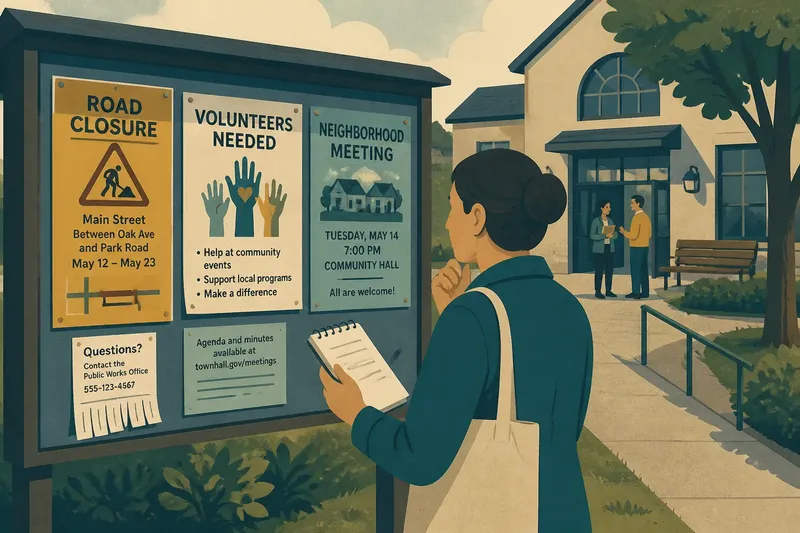
The common mistake with public information is to treat a notice as the whole story. Reading public information well means spotting what a poster actually tells you—and what it leaves for a meeting record or a direct question. Confusing those sources can send neighbors to the wrong place or make an invitation sound like a decision already made.
A noticeboard outside a library might carry a road-closure announcement, a call for volunteers, and a neighborhood meeting flyer. Each can be useful, but none holds the full exchange behind it: who raised a concern, which options were considered, or how residents can reply. A notice is like a label on a jar: it identifies what is inside, but it is not the meal.
Read a notice for the job it was made to do
Public notices make particular information visible. They may announce a time and place, describe a service change, invite comments, or direct people to a formal process. Limited space often leaves out the background a reader needs to understand what the message means.
Identify the notice’s purpose. Is it announcing an event, asking people to participate, recording a decision, or explaining how to comment? Those are different acts. “Meeting Tuesday” is an invitation; “Work begins Tuesday” is an announcement. Neither explains the reasons or gives a full account of what was discussed.
Look for the issuing group, contact method, date, specific location, and any reference to minutes, a proposal, or an official notice. If details are missing, the paper may still be useful, but it offers less footing for follow-up. A handwritten note from a volunteer and a formal notice from a municipal office can both matter locally while carrying different authority.
Careful reading need not mean suspicion. Keep a claim in proportion to its source. A flyer can tell you that its organizers want people at a gathering; it cannot establish that all residents agree or that a proposal has been approved unless it supports those claims.
Find the right source for the question you have
When a headline leaves something unanswered, choose the source that can answer that particular question. A notice, a record, and a conversation do different work; use this check to decide where to look next:
- What is happening? Check the notice for the event, service change, place, and contact. If the date or location is unclear, ask the issuing group before making plans; otherwise, use the notice for the immediate details.
- Was this discussed or decided? Check the relevant agenda and minutes for a recorded decision, recommendation, or pending action. If the item is absent or its status is unclear, ask the clerk or responsible group; otherwise, treat the record as evidence of what was formally recorded.
- Why was this choice made? Look for a supporting report or written explanation. If none is linked, ask the responsible group where its reasons are recorded; if a report is available, read it alongside the notice rather than assuming the short announcement gives the full rationale.
- How can I respond? Check for a comment route, meeting, contact, or formal procedure. If the notice gives none, ask the issuing organization where responses belong; if it does, follow that route and note any stated deadline.
- What does this mean for my situation? Contact the office or person responsible for the service, place, or event. If your question concerns access or scheduling, state that detail; if the first contact cannot answer, ask who can.
- Who stands behind this message? Check the named issuer and its role in the matter. If the source is unclear, seek confirmation from the organization the notice appears to concern; if the issuer is identified, read its claims within the limits of its stated role.
Format alone does not settle authority. A town website may host a document written by a local committee without endorsing every statement in it. A poster on a community hall door may be the clearest invitation, while a council agenda may be the right place to trace a formal item. Ask who issued the message and what role that group has in this matter.
Use each source for what it can establish
Check the notice for immediate details
A notice is often the quickest place to find what is happening, where, when, and which office or group is responsible. Use it to decide whether to attend, avoid a place, bring something, or pass an event along to a neighbor.
Check whether a date refers to the event, a response deadline, or the day the notice was posted. Make sure the location is specific enough to act on; “the hall” may be ambiguous if there is more than one nearby. A listed contact may handle accessibility, registration, comments, or general questions, so check the stated purpose rather than assuming one person speaks for every group involved.
Read records for formal discussion and action
Minutes, agendas, council papers, and committee notes can show what was scheduled, which recommendation was recorded, and what action was assigned. They help trace the formal path behind an announcement, particularly when it refers to a proposal or decision.
Records have limits. Minutes are selective accounts, not transcripts of every remark or maps of every disagreement. An agenda shows what was planned for discussion, not necessarily what people said or what was resolved. Distinguish a report, recommendation, vote, and pending action. If a document says an item was “noted” or “referred,” read the surrounding text before deciding whether a final decision was made.
Ask a person when context changes what you do
A conversation is useful when you need an explanation, want to raise a concern, or cannot tell which document applies. The right contact might be a clerk, event organizer, facilities manager, neighborhood association, or staff member named on the notice. Ask about the specific item rather than asking one person to explain an entire local process.
Say you see a library notice that a side entrance will be unavailable during a program, but it does not say whether the main entrance remains open. You contact the library using the notice’s details and ask about that entrance during that event. The expected result is an answer about access or a referral to someone who can provide one—not an assumption that the short notice covers every practical consequence.
A conversation can clarify intent, but it is not automatically an official record. If a response affects your next action, ask where the relevant policy or written update is available. That keeps personal explanation distinct from formal information without dismissing either.
Notice the verbs that signal a message’s status
Ordinary wording can hint at where a public matter stands. “Proposed” suggests a choice remains under consideration. “Approved” signals an authorization, though the notice should identify who approved it. “Consultation” usually means views are being gathered; it does not say by itself how they will affect the outcome. “Opening” may announce an event without promising that every facility or service will be available.
Pay attention to what the notice asks you to do. An invitation to attend, register, comment, volunteer, or avoid an area has a different purpose in each case. If it invites responses, check where they go and whether a deadline is stated. If it announces a change without offering a reply route, you can still contact the named organization, but do not mistake the announcement for an open consultation.
A missing detail is not proof of a hidden meaning. A notice may omit reasons simply because it is brief. Treat that gap as a reason to seek another source, not as evidence that someone is concealing a decision. A fair, specific question is more likely to clarify what is missing.
Which source answers common public-information questions?
Should I trust a notice posted by a local group?
Read it as information from that group, then check who the group represents and what it is responsible for. If it claims that an official decision was made, look for the relevant public record or contact the organization named as responsible.
Do meeting minutes capture what everyone said?
Minutes usually record meeting business rather than every contribution word for word. Use them to check the agenda, recorded outcome, and assigned actions; ask the organizer or clerk where fuller background is available if you need it.
What can I do if a notice has no contact details?
Look for the name of the issuing office, venue, or group and use its publicly listed contact route. If the notice is anonymous and its source cannot be identified, treat its claims cautiously and seek confirmation from the organization it appears to concern.
Can I ask a question after a decision is announced?
Yes. Ask the responsible organization where the decision and supporting information are recorded, and whether a review or response route remains open. The answer may clarify the process even if the decision itself is not being reconsidered.
Keep the source attached when you pass information along
If you need an event time or contact name, the notice may be enough. To learn what a committee formally considered, use its agenda and minutes. For a reason, practical clarification, or response route, contact the responsible person or group and ask where the written information sits. A record can establish what was recorded; a conversation can explain where to look next.
When an answer depends on an official label, an organization’s instructions, or local rules, check the issuing authority’s current material or consult a qualified professional where appropriate. For ordinary civic questions, name the notice, identify the missing detail, and ask who can answer it.
Before forwarding a notice, keep its source attached: say which office or group issued it and where questions should go. That small bit of context helps the next reader distinguish an announcement from a decision and find the people behind the words.